|
I met Neil Denari last June, in UCLA architecture school. Before his panel talk, we had a five-minute conversation.
I heard the architect's name during the 90's, when he became the director of SCI Arc. I then saw his project Massey House, in news. Last year I saw his installation work, Fluoroscape, and started to read the material with his name attached whenever I saw one.
I saw the little-big architectural piece called LA Eyeworks recently, a fashionable eyeglass store in Los Angeles.
As so many people who talk about NMDA's work do, I too, instantly liked the forms and lines they drafted, sculpted, and installed.
It is a common instinct to like the form first.
It happens with all the arts. When some other postulations evaporate, form usually saves the day. I trust it. However, I am not naive enough to be blinded by it alone. I don't go home and say "My, what a form that was!" I try to see the rest of the layers and if they are there, you have good work in front of you, by an architect who can "connect the form."
Denari's lines invoke an instant feeling of fluidity, and their compositions are meticulous. The layers connect quite minimally, clearly and colorfully. And there is this honest intellectual rigor and proactiveness to them, as if they are situated in being ahead of their time, demanding hard work and posing a lot of challenges in their flight.
As arranged, I met him at 11 am in his office, NMDA, on Washington Blvd. in West LA. Inside 60's discreet storefront approx.1500 sq. ft. with industrial desks lining the walls, I saw a dozen architects (including Denari) working on their projects. It is a busy office dealing with more projects than ever.
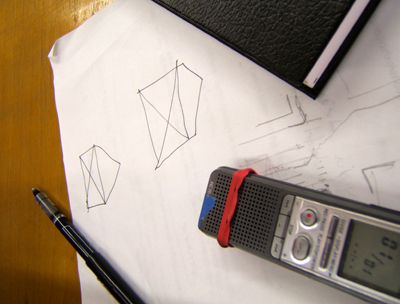
Over a cup of coffee, I activated the tape recorder and asked some random questions.
OA- I have been following the recent prefab homes’ doctrinated efforts with a blur in my eyes and a camera in my hand. And, out of all the samples I have seen so far, I am still not convinced that anybody came out with a model that truly deals with manufacturing, affordability, cultural placement, city and housing issues. What are your thoughts of recent prefab production rush?
ND- Well, we have just finished a competition for MoMA who will build five prefabricated modern houses next year. We did not win but we got into the last twenty. It was supposed to be fabricated on 165K.
The thing about prefab, the houses are prefabricated and the ideas are prefabricated. A little bit of a critical comment on my part, but obviously the issue with prefab now is the same issue it has always been throughout 20th. century. It is about how to use the technology transfer. Prefabrication is a plain form of talking about the technology transfer. To be able to produce a mass produced product that would work financially and commercially in the market place. You can also do a 'one of a kind' project prefabricated in a factory but not intended to be repeated everywhere.
OA- Ray Kappe's prefab house ideas come to mind. Especially the second one, the best modern architecture a collector could buy in today's market, but it is not for large sector.
ND- Pretty much... You can build something that can never be built again, cost a lot of money and you can still say it was prefabricated. You can run into so many dead ends that way because you can never produce enough of them to get the cost down. However, obviously today prefab means marketable, mobil home technology for permanent architecture. So, you still trying to get the cost down and at the end you are building them like a normal house. Wood or steel frame, put the drywall inside, put the skin and ship it in a box or tow as a trailer, while still trying to beat the cost of building on site with the labor.
OA- Precisely mundane. The way housing construction produces homes these days, most construction is prefabricated anyway. You just screw them together at the job site. It is pretty much stream lined already. Somebody sizes and quantifies the members, put an order in the lumber yard, frame it at the job site, the way its shown on the blueprints. Majority buyers do not like Fedex’d house because they associate it with trailer park living. So they screw it together at the job site with completely stream lined process from cad drawings to wallpaper and call it custom...
The prefab business in Dwell sense, on the other hand, has to keep doing Kappe Homes because he is pretty much the hot property in this venture. I keep bringing up that one, because I was at the opening of the first one... I like Ray's work. I’d buy the second one, for example of course. Now he is a blue chip modern master and his lines actually do connect all the way to 50’s scene in Los Angeles. Interesting timing thing for Ray Kappe... Anyway, go on...
ND- I guess I am on the side of those that you are going to make this object and replicate it like a print. We have a project may hopefully start in Vancouver for a client who came to us for a prefabricated house. He liked it to work on many sites, and he sent us a bunch of images; early 60's Italian and Japanese cars. He said, "we are coming to you because you have a strong interest in the fluidity of the form and so forth. And we are coming to you to see if you can get the technology and the form and do things that are more difficult to do rather than the conventional house prefabricated."
OA- Good request and direction from the client. Let us say, millions of Toyota Homes. Roll them out. Funny enough, they brought you the pictures of Japanese cars to start the design process for the prefabricated house they want to manufacture. I personally think, it is the car industry that eventually will manufacture homes. I love it. I see the shipping containers as kitchen remodels in comparison.
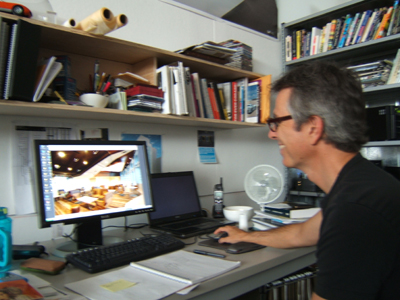
He shows me the picture of NMDA’s entry to MoMA competition on his computer screen. They use a typical urban lot in Los Angeles or something similar and expand upon a new possibility, increasing the density, allowing another house on the lot, allowing them to go higher and actually reducing the footprint. Addressing the technology transfer and urban transformation at the same time. Best prefab I have seen in its class. It looks like ready to go... They sit there, as if they were dropped off and bolted down this morning.
(There is in fact such a zoning change in Los Angeles.)
It is a wake up call for all those urban enclave, idyllic lakeside or enchanted desert prefab dwellers out there. I wonder if the MoMA prefab housing competition winners will work within the urban context of a city like Los Angeles... It is a great application of prefabricated housing for a city who is adding another unit and a story on its standard lot. Your next-door neighbor has an SUV. It is now. The landscape is familiar with curbcuts and everything.
I snapshot the rendering he shows me on his desktop.
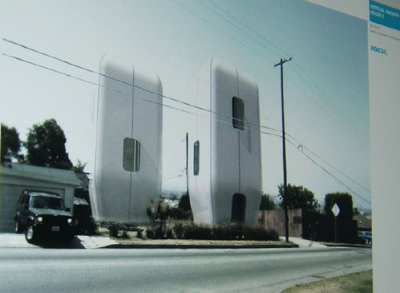
NMDA prefabricated dwelling proposal for MoMA
ND- Industrial design is a big influence for me. As much as the hard core aspects of architecture, of course.
It is also a big challenge to transfer technology on that scale. There is a wide idea of pragmatics involved. Pragmatics don't necessarily come pre determined for the formal language.
OA- You search and find the pragmatics of the object, which can be elusive by its non-sign nature.
ND- Yes. And there are things in it that don't immediately get written in the same way the functional argument in architecture gets written, such as; this must be next to that, and this must be shaped like that.
I am interested in trying to argue for what I do, as opposed to saying "look, this is my stuff so I get to do it like I own it, it's a priority thing. While there might be some aspect in the formal language that is unique, I am not somebody who says, "I get to do that because I made it and don't ask me any questions about it." I am still interested in trying to find it's place.
OA- Fair enough. A lot of young architects attribute this..., "Folded form' in recent architecture idea to you. At least they say, “Neil Denari does it best.” I do not think that, because I can put it in the wayback machine and see some of this stuff right there in art and architecture. There are light and boundary ideas in James Turell's work. There are topographical sheet metal sculptures by David Rabinowitch during the sixties, there is Schminke House by Hans Scharoun in 1933, and so on. However, if you come to the 1990's, people attribute certain things to your work and efforts in that context. It is said among the students and recent graduates that you are the man, regarding what I have just described... What do you say about this?
ND- I always wanted to pursue building. It wasn't like I came out of the cave and said I want to design buildings. Since the early 80's I was always interested building hi-economy projects -meaning if you put in a little you get a lot, which is a modernist idea. Then develop a set of strategies that are very buildable. One of the reasons many architects were able to use the same method, because it is eminently buildable. I was very conscious about wanting to be able to realize this work. And, it is not very hard to look at it and see this hi-economy thing. There is a maximum-spatial effect although we are dealing with Cartesian systems. We are using extrusion, radii, intersection or the thickness of the surface, this stuff has been incredibly dramatic in it's 'finished' sort of input. That's why I call this hi-economy. Therefore it is not as peculiar as, lets say Frank's (Gehry) work with it's masterful interplay of a different set of proportional issues. I probably have enough conventional and organizational systems in my work that people are able to expand upon. I don't say oh great I am happy I introduced something to calibrate, I have no comment on that. I am just happy I get the opportunity now start building the unfolding work.
OA- I was reading your explanation of 'world sheet', I see it as a diagram in Gallery Ma.
ND- It is a simple abstract diagram. It has a form in it and enough conceptual abstraction to have weight, although I am not claiming it to have a meaning in a literary or historic sense. It is a buildable proposition and since we have introduced the concept, we have been able to mutate it and still work with the principles of it.
OA- I admire the simple beauty and the utilization of a single concept. You don't have to come up with idea after idea. Sometimes one good idea is all you need to use as your port.
In one of your texts, you refer your folds of walls and ceilings etc.., 'de-formations'. Excuse me if I am mistaken, I see them as more like 're-formations'. Is my point significant?
ND- The idea of de-formation would be like, there is a normative thing and then you de-form it. The implicit thing is, there is a Cartesian geometry and there is a topological geometry. Topological is a deformation from Cartesian because the Cartesian is understood to be the architecture of gravity, architecture of everyday life and architecture of normative life. The topological form is a holy grail for certain architects. For me, and I said this in my book Gyroscopic Horizons, I cannot strictly determine an ideology based on a narrow vision of geometry. If you think of re-formation, it could be boiled down to formation. Because re-forming means to correct something and de-forming means to make something incorrect for the normative world. In fact it would more appropriate to call it formation of a surface or formation of a space. I use the word de-formation as in a contemporary teaching world as if to perform a critique on a normative world. My stuff is aggressive but not in a polarizing way. It does things without shouting, but when you kind of look at it you realize something is going on spatially, appearing as something new or uncertain. One client calls it as walking around being drunk.
OA- That's good to know. I like that. Little bit like, flirtation with unknown... I talked to people in La Eyeworks and they say it is a great place to work. They like you there. Very knowledgeable people about eye glasses, your design is a definite component to their business.
I realized this could go on and on.
I change the pace, We talk and acknowledge few names; Andreas Gursky , Herbert Marcuse and One-Dimensional Man.
At that point, looking at my notes, I remember seeing an adventurous review of Denari's book Gyroscopic Horizons penned by Philip Nobel in Metropolis Magazine, dated 1997, in which Mr. Nobel asks "Why does Denari do what he does?"
Since this is not that kind of an interview arranged by a PR person, I can do whatever I want... What a great idea... I will ask a question from a known critic. Use it as my prop... The set designer in me...
Assuming he has read that review, I remind and repeat Philip Nobel's philosophical question.
OA- (With a minor gusto, I ask) Why does Denari do what he does?
( short space)
ND- Well, he said Neil Denari has the luxury of not having to build.
Of course not. I always wanted to build. When he wrote that we didn’t have any buildings yet. You know I am an architect. I am fighting tooth and nail to get projects, get them built. I am not a millionaire. We are not a big commercial office. I found his reading at the time primitive. It takes a lot of time and experience to get to the place to build, so this is my time now, we are building etc... He might have a different view now after ten years. Maybe...
Obviously, his feelings were hurt as a hard working middle class dad. At least that is what I observed from his first blush... I doubt it would be a luxury not to build for any architect.
Denari goes on to talk about his work. Being face to face, it helps to put the real person behind his practice and the 'why' question. I see day-to-day production of architecture in his busy office. I notice he knows all about the models, design moves, drawings and notes they put on production documents they make. The office is in control of doing the architecture. They have clients...
As he is answering to my question, I sort of start to travel in my mind about the same thing, not listening what he is saying. My bad.
Why I do, what I do?
I do it because it needs to be done by me, as in; most architects have things that are need to be done by them.
They do it all the time and if the work has a slight autonomy, it gets attention. It would not be a luxury if I don’t do it, for it would lead to some kind of stagnant title that conflicts with the nature of architecture. Static architecture must die. Whoa...
Yes, I went that far in a split second (listening to tapes later, all this took in 1;04 min.)
Most of us chase excellent adventures. I notice a thick set of blueprints, half opened with drawings and notes on them, title block reads NMDA Architects. Why do they do that?
Because they are architects, I conclude.
I realize the condition of Phillip Nobel's question. It is an ultimately an open ended question and could be answered across the board. So what? The question starts to fade away.
At this point, it is more important to me to see what Neil Denari does, rather than why he does.
“Why I do, what I do?” at this point, sounds like a crude Ed Ruscha painting in my imagination.
OA- How do you define risk taking when it comes to architecture?
ND- The risk is not doing it, not trying to be innovative or making your project as experimental as possible. Like sitting down and talking with a fellow architect, Thom Mayne for example, is he going to take a job in Dubai or not? What is the opportunity about? For him, it is just not doing another building. I believe that too, even we have done a handful of buildings. I am not interested in having a hundred person office just to have hundred person office. At the end, you just have to have a lot of energy, just keep going because it is easy to be shot down on the margins. Energy is the main factor.
The other thing is, you have to be in attack mode instead of protecting mode. We know a lot of people in that protecting mode, we won't name any names but there are a lot of people who will say, "well it is not worth the risk anymore." For me, it will always be an attack mode.
OA- It is like life. Once you stop expanding, I would say, "What’s the point?"
ND- I agree. You very much strike me as a person who is in that expansion mode. The fact that you do this and are probably interested in whole range of things from politics to visual culture and doing all that in a different culture than the one you came from, it is in fact very impressive.
OA- Thank you. I have many fronts. Searching for a refuge in constant struggle. I think having two different cultures in your development has its price. However, if you pay attention and explore, it can get delightfully rich, interconnected, complex, challenging and poetic in terms of the physical language, if there is such term. Like having globalism literally chipped under your skin but you are still connected to different geographies. I am from transition generation. From, radio days to goggle in several short decades. It is very rich. Sometime I feel like I am running out of space in my mind. My mind as a jobsite...
ND- (laughing) Right.
OA- Anyway... You teach, you practice architecture, family and all that. You are dealing with many fronts as well. You are a well known teacher. How do you engage and disengage your own projects and school projects?
ND- For instance, I teach what I am interested in but not what I do. I write studio projects about what I am interested in but not have resolved. All the various projects I write are open ended but I have a sense about the phenomena what they are. I had a studio in UCLA about 'branching buildings', I said, "of course branching buildings don't happen because they are not efficient and they don't work, with all diagonal elevators and all. Market will not allow them to happen at any scale, but I am interested in that, so I wrote the project and we did it, although I have not done a project like that in the office. We also did a yearlong project about graphics. What the graphic world means for architecture? We worked with that and it is not as if I provided a blueprint.
OA- What about writing? Writing is a different animal. You also write. You have written a book.
ND- Yes... Writing comes and goes. The bulk of the writing I did for the book I re wrote. It is what it is. I refer to material in it from time to time based on the stuff I am still interested. I write differently now because in time, it rather develops. Right now, I write like a thousand words, little essays for myself. Sometimes they are commissioned for a journal or something like that. Sometimes I write to get my ideas across, even to myself. Most of that stuff, I use for lectures. I am perfecting my deliveries of lectures, working on them to become clearer and clearer.
OA- You read Archinect, don't you?
ND- Yes I do. The thing about Archinect, you have to open yourself to every cynical comment, similar to learning how to read bad reviews.
OA- I get cynical comments, I make them, people write me nasty letters, secretaries call me on behalf of people I wrote about etc. It is the nature of internet text... It is not one way traffic.
I'd like to change the subject... Can you draw an open envelope without lifting the pen?
He says, "Sure." I quickly show him how it is done saying, "it is a stupid drawing but I would never ask you if the envelope was closed." I give him the pen, push the paper, he tries...
You have to have some courage, innocence and humor.